Sunday, 15 July 2018

6 Workout Signs That You Need to Change Exercises

When you find an exercise routine that you like doing and are able to do may take a lot of time and dedication and you may think this routine will help you reach your target. But with the repetition of the same type of workout, your body will get used to the exercise routine and will consume less energy.
If you change the exercise routine, your body will be continually challenged and it will change, resulting in a more successful target hit. In addition, you can avoid repetition and boredom. The change can be made in the intensity of the workout or in the type of workout. You may also increase the time spent working out.
When considering the topic of, when or how often to change your exercises, here are some guidelines to make good decisions about this important programming variable.

1. Exercises That No Longer Work.

There’s a phenomenon known as “adaptive resistance” that plays a big role in the need to change exercises. For example: Remember the first time you squat? You may have only done 95 for 3 sets of 10, the next morning you felt those muscle DOMS!

2. When Your Weakness Becomes Stronger.

Training is always about identifying the problems in your overall plan and then finding solutions to those weaknesses in the form of new exercises that correct the problem.
Maybe you used to have problems at the lockout part of your bench, you spent time bringing your triceps strength. Now, your new sticking point is close to your chest. This new constantly evolving scenario suggests the need for more pec work, so you’ll drop a few triceps moves in favour of additional pec work.

3. Anything Causing Pain.

You just wrote up a new training plan. Sure enough, the new chest exercise you planned hurts your shoulder.
A lot of lifters would stick to the plan and work through the pain. But you should make a substitution right then and there.

4. Exercises That Might Not Work With A New Training.

Not all exercises are appropriate for all rep ranges. This means that when you switch from a hypertrophy phase to a strength phase, you’ll need to change at least some of your exercises.
In general, dumbbell, cable and bodyweight drills tend to be most suitable for higher-rep, while barbell and some machine exercises are better suited for low-rep training.

5. Changes To Goals And Priorities.

If you decide to amend your initial target, you’ll need to make some significant changes to your exercise plans.
Or, maybe you’re coming to the conclusion that you’re placing low because your muscle strengths aren’t where you want them. This means that you might need to temporarily eliminate some other exercises to accommodate your priorities.

6. Broaden Your Perspective.

Despite our best efforts and workout plans, we often find ourselves in a routine and we end up narrowing our exercise choices unnecessarily. It’s a good thing to periodically try new things, even if your current exercises seem to be working well. You never know, you might find something really valuable.

10 Minute Home Bodyweight Abs Crusher Workout

1. Hollow plank

Why: It works your all abs muscles, including the deep-lying stability muscles, as well as strengthening your lower back.

2. Plank side-to-side feet jump and tuck

Why: It works your upper and lower abs, as well as your obliques (side abs)

3. Bicycle crunch

Why: It primarily works your obliques, but your upper and lower abs are also heavily recruited to keep your upper back and feet up off the floor.

4. Rolling plank

Why: A tough variation on the classic plank that places more emphasis on your obliques.

5. Heel touch

Why: Far harder than it looks, this move works your upper abs and obliques.

6. Side plank crunch

Why: Another move that works your obliques, while the crunch movement recruits the small stabilising muscles to keep you balanced.

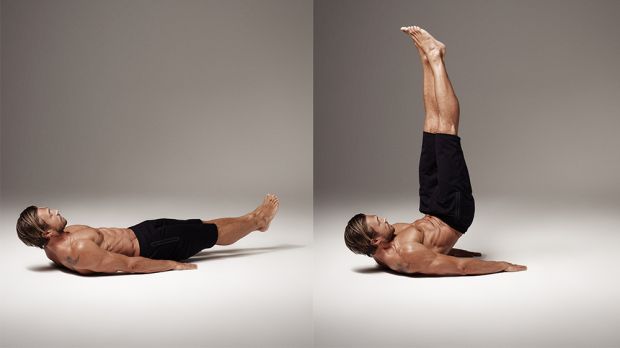
7. Legs-together hip thrust

Why: One of the hardest and best ways to work your lower abs, which is crucial if you want to turn a four-pack into a six-pack.

8. Press-up kick-out

Why: A challenging but rewarding move that works your chest and shoulders as well as your abs.

9. Plank with leg raise

Why: Raising your legs alternately will force your entire core to remain activated for the full 20 seconds of work.

Saturday, 14 July 2018

3 Workouts To Earn Your Burn In Just 10 Minutes

Sometimes it can seem near impossible to find time for a full-length workout every day.
The good news is, we have three time-efficient workouts that you can slot in at almost anywhere and at anytime – even in front of the telly!

1. The Lounge Room Workout

Don’t feel like exercising?
Well here’s a compromise that you can do in front of the TV, but still burn some calories and strengthen you up! 
Duration: 5 minutes
Workout:
Side plank lifts x 12
Side leg raises: x 12
Side Tricep push x 12 
Work through the circuit by doing all one side first, then roll over and do the other side. Repeat until both sides are completed twice.

2. The Core Flexor


Got a spare ten minutes? This workout will put your core to the test…and will be over before you know it!
Duration: 10 minutes
Workout:
Genie Sit – 30 seconds
Rest – 15 seconds
Hollow Body Hold – 30 seconds
Rest – 15 seconds
Forward Arm Walkout – 30 seconds
Rest – 15 seconds
Repeat x 4

3. The Cardio Energiser

PUMP up your favourite tunes because this workout is HIGH energy…and all over in just five minutes! 

Smash this one out indoors or outdoors.

Duration: 5 minutes

Workout:
Basketball Jumps x 12
Mountain Climbers x 12
Front Kicks x 12 (per leg)
Rest + Repeat x 3

Friday, 13 July 2018

Build Muscle Plan

  1. Push-ups: Primary push-ups are mainly targeted towards the pectoral chest muscles and the shoulder muscles. Commence your push-ups with the high plank positions with keeping your hands firmly on the ground, exactly underneath your shoulders. Make sure that the spine is kept neutral. Next, lower your body down till the point when your chest is right above the floor. Push yourself up in order to complete one repetition. Perform one set incorporating 15 repetitions as a warm-up and then 2-3 sets of 10-15 repetitions as a finisher.
  2. Pull-ups: This majestic exercise targets Lats and Arms. Firstly, grip tightly a pull up bar and using your arm strength pull yourself up over the bar by making sure that there is a slight arch in your back. Now slowly lower yourself down until your arms are completely stretched to finish one rep. You should perform 2-3 sets of 10 reps in the beginning and then two sets of 10 reps as a finisher.
  1. Squats: The primary targets of squats are Quads, Hamstring and Hip Flexors. Get into the starting position with your legs shoulder width apart. Keep your hands folded together at your chest. Start coming down by keeping your knees firm and hips clasped. Sit back using your hips as you were sitting in a chair. Go deep within and return to starting position to finish one repetition. You could do 4-5 sets of 15 repetitions each as a warm-ups and 2-3 sets of 15 repetitions each as a finisher.
 following are the few golden dietary tips one must adhere to:
  • Eat 3 meals a day with pre- and post-workouts.
  • Ensure you intake sufficient number of calories at every meal and snack through beverages and food.
  • Add plenty of carbohydrates into your diet such as boiled potatoes, cereal, rice, pasta, fruits and vegetables.
  • Increase the amount of proteins in your diet by including soya products, milk, eggs.

Thursday, 12 July 2018

6 Surprising Benefits of Massage

Massage can help reduce pain from exercise.


Research indicates that massage therapy can reduce inflammation of skeletal muscle damaged through exercise

Massage can make you look younger
Massages stimulate blood flow, which is why regular gentle rubbing and kneading might keep your face looking healthy and radiant

Massage can help beat PMS
A massage could banish mood swings, bloating, headaches, weight gain, and other PMS symptoms, according to a study by the Touch Research Institute and University of Miami Medical School. 

Massage benefits chronic pain relief
Sufferers of chronic soft tissue pain (arthritis, fibromyalgia, disc problems, degenerative joints) can find relief after only a few massage therapy sessions, says Nancy M. Porambo, licensed massage therapist with the American Massage Therapy Association


Massage can help treat side effects of cancer
Researchers in Boston found that patients with metastic cancer reported better sleep, less pain, and overall better quality of life after receiving massage therapy.

Wednesday, 11 July 2018

How Cardio Exercise Can Help You Lose Weight

How Cardio Helps You Lose Weight

It's common knowledge that weight loss happens when you create a calorie deficit, burning more calories than you eat. While some people prefer to cut calories through their diets, it helps to have a combination of things— cardio, strength training, and a healthy low-calorie diet.
Women in a fitness class
All of those are important, but cardio is a key component because:
  • You burn more calories at one time - Getting your heart rate into your target heart rate zone means your blood is pumping, you're breathing hard and you're sweating. As soon as you get into that efficient calorie-burning zone, your body burns calories. The harder and longer you work, the more calories you burn. For example, a 150-lb person can burn up to or more than 200 calories during a brisk 30-minute walk.
  • You can easily add intensity to increase your calorie burn - With cardio exercise it's easy to increase your calorie burn with small changes in intensity: Going faster, jumping higher, climbing hills or trying new activities that your body isn't used to.
  • It adds to your overall calorie deficit - Burning calories with exercise means you don't have to cut as many calories from your diet. That is as long as you don't compensate for the workouts by eating more later in the day, which can happen to some people.
  • You can do cardio most days of the week -When you lift weights, your muscles require rest to recover and grow stronger. Cardio can be done most days of the week without worrying about injury or overtraining, depending on how you set up your program
With that said, some Cardio exercises offer more intensity than others.
  • Impact activities: Exercises that involve some impact, like walking, will usually boost your heart rate faster than no-impact activities like swimming or cycling.
  • High impact activities: High impact, or exercises that involve running or jumping, will often burn more calories than lower impact things like walking. You don't even have to do an entire workout with high impact moves. You can simply choose a few and add them to your current workout and you'll burn more calories.
  • Whole body activities: When you involve both the upper and lower body, as in cross-country skiing, it's often easier to get the heart rate up and burn more calories. You can also do this by doing compound strength exercises. When done right, you get a great cardio benefit even as you build strength and endurance.

Tuesday, 10 July 2018

What's a good way to gain weight if you're underweight?

Here are some healthy ways to gain weight when you're underweight:
  • Eat more frequently. When you're underweight, you may feel full faster. Eat five to six smaller meals during the day rather than two or three large meals.
  • Choose nutrient-rich foods. As part of an overall healthy diet, choose whole-grain breads, pastas and cereals; fruits and vegetables; dairy products; lean protein sources; and nuts and seeds.
  • Try smoothies and shakes. Don't fill up on diet soda, coffee and other drinks with few calories and little nutritional value. Instead, drink smoothies or healthy shakes made with milk and fresh or frozen fruit, and sprinkle in some ground flaxseed. In some cases, a liquid meal replacement may be recommended.
  • Watch when you drink. Some people find that drinking fluids before meals blunts their appetite. In that case, it may be better to sip higher calorie beverages along with a meal or snack. For others, drinking 30 minutes after a meal, not with it, may work.
  • Make every bite count. Snack on nuts, peanut butter, cheese, dried fruits and avocados. Have a bedtime snack, such as a peanut butter and jelly sandwich, or a wrap sandwich with avocado, sliced vegetables, and lean meat or cheese.
  • Top it off. Add extras to your dishes for more calories — such as cheese in casseroles and scrambled eggs, and fat-free dried milk in soups and stews.
  • Have an occasional treat. Even when you're underweight, be mindful of excess sugar and fat. An occasional slice of pie with ice cream is OK. But most treats should be healthy and provide nutrients in addition to calories. Bran muffins, yogurt and granola bars are good choices.
  • Exercise. Exercise, especially strength training, can help you gain weight by building up your muscles. Exercise may also stimulate your appetite.